
The Long Cycle Notes
Is Vietnam a good alternative to China for ceramic dinnerware in 2026?
For many stoneware programs, yes. Vietnam now makes stoneware dinnerware, mugs and bowls at retail standard, with automatic forming lines and growing decoration skills, and Vietnam-made goods avoid China-only costs such as the EU's 79% anti-dumping duty and the Section 301 duties the U.S. has applied to Chinese goods since 2018. China still covers shapes and decorations Vietnam does not yet do at scale. Most buyers run both, each item where it is strongest.
Why buyers are asking this now
Three things raised the cost of China-made ceramic dinnerware in 2026, and none of them came from a factory price list.
- EU anti-dumping duty. Since 7 February 2026, ceramic tableware and kitchenware originating in China pays a single EU anti-dumping duty of 79.0%, up from company rates of 13.1% to 36.1%. See what the EU duty means for buyers.
- U.S. Section 301 duties. The Section 301 duties the U.S. has applied to Chinese goods since 2018 and 2019 still apply to China-origin products, on top of the duties that cover other origins. U.S. duties changed several times in 2025 and 2026, so price every program on the rate in force at entry.
- China's export VAT rebate. From 1 April 2026, China removed the export VAT rebate on porcelain and ceramic tableware, kitchenware and decorative ceramics, which raises the export cost of China-made items before any import duty.
At the same time, Vietnam's ceramic capability has moved faster than most buyers' assumptions. The answer a buyer got twelve months ago is already out of date.
How Vietnam and China compare for ceramic dinnerware
| Vietnam | China | |
|---|---|---|
| Stoneware dinnerware, mugs and bowls | In regular production at retail standard | Mature, full range |
| Forming | Automatic forming lines running for ceramic vessels; open molds shorten development | The deepest mold-engineering and tooling base |
| Decoration | Solid, reactive and textured glazes; hand painting delivering; decals reaching retail standard step by step | Full range, including complex decals and specialty finishes |
| Sampling | About 21 days | Quoted item by item |
| Production | 75 to 90 days; around 90 days for a first order | Quoted item by item |
| MOQ | 2,000 to 5,000 pieces per design | Quoted item by item |
| EU anti-dumping duty | Does not apply when genuinely made in Vietnam | 79.0% since February 2026 |
| U.S. Section 301 duties on China | Do not apply | Apply to most China-origin ceramics; check your HTS code |
| Export VAT rebate at origin | Not affected by China's change | Removed from April 2026 |
| Origin paperwork | Certificate of Origin with every shipment | Standard export documents |
The Vietnam figures are typical for our programs and move with the shape, the decoration and the season. We confirm exact MOQ and timing when we quote.
What we see on the factory floor
When the tariff wave first hit, buyers started asking us about ceramic capacity in Vietnam. The honest answer then was terracotta, garden pots and rustic outdoor pieces. Good products, but a long way from tableware-grade execution.
We decided the capability gap was the opportunity. We started building our Vietnam ceramic supply chain in 2024, before tariffs on our categories were more than a rumor, and worked through factory development, technical transfer and trial after trial. A partner asked why we moved so early. Our answer was not a forecast. When trade rules are being rewritten, the buyers and suppliers who move early take the seats that open up.
Today fine stoneware dinnerware is in real production. Body quality, glaze consistency and flatware tolerances, the fundamentals that separate a garden pot from a dinner table, are holding. Automatic production lines for ceramic vessels are running, not planned. Hand-painting programs are delivering, and decal application is coming up to retail standard step by step. With automation and better yields, Vietnam ceramics now works for mainstream tabletop programs, not only the outdoor corner where it started.
We don't own the factories. As a sourcing and product development company, our work is qualifying factories, transferring technique, running the trials and inspecting production, which is what lets us place each item where it is strongest rather than where our own kilns happen to be.
The lesson we keep re-learning: capability does not migrate by waiting. Someone has to walk the floor, run the trials and absorb the failures until the line runs clean. Supply chains don't move. They get built.
When China is still the better origin
China remains a core base for us, and for some dinnerware it is still the right answer:
- Items that depend on tooling, decoration techniques or materials that Vietnam does not yet cover at scale.
- Small runs where new tooling in Vietnam would not pay back.
- Fast repeats that can run on a line already set up in China.
The practical answer is usually not either-or. Put each item where it is strongest, and keep a second origin ready for the items most exposed to duties.
What to check before you place the order
- Production proof, not just a sample. Ask to see the item on the production line, or a pilot run from it. A hand-finished sample proves the design, not the line.
- Lead and cadmium testing. For the U.S., FDA sets leaching action levels for ceramic ware by category, and California's Proposition 65 is stricter for lead. Test every new glaze and decoration before shipment.
- Glaze and color control. Agree on color standards and approve the first firing batch. Glaze color can drift between firings and between factories.
- Flatness and fit. Check plate flatness, stacking and lid fit on production pieces, not on samples.
- Retailer performance tests. Confirm which dishwasher, microwave, oven and chip-resistance tests the retailer requires, and test to them.
- Origin documentation. Ask for a Certificate of Origin with every shipment, and make sure forming, glazing and firing happen in Vietnam. We do not transship.
- The duty for your code. Confirm the classification and the current duty for each origin with your customs broker before you price the program.
Sources (accessed 2026-10-09): Commission Implementing Regulation (EU) 2026/274; USTR, Section 301 tariff actions on China; Ministry of Finance and State Taxation Administration of China, Announcement 2026 No. 2, Annex 1 (as reproduced by the Hong Kong Trade and Industry Department); FDA CPG Sec. 545.450 (lead) and CPG Sec. 545.400 (cadmium); OEHHA, Proposition 65.
Planning a dinnerware program across two origins? See ceramic dinnerware, our Vietnam ceramics capability and the China-to-Vietnam case study, or start a conversation.
Frequently asked questions
Can Vietnam make stoneware dinnerware for U.S. retail?
Yes. Stoneware dinnerware, mugs and bowls are in regular production in Vietnam at retail standard, including body quality, glaze consistency and flatware tolerances. Hand-painted programs are delivering, and decal application is reaching retail standard step by step.
What are typical MOQs and lead times for ceramic dinnerware made in Vietnam?
In our programs, typically 2,000 to 5,000 pieces per design, about 21 days to sample, and 75 to 90 days to produce, with around 90 days for a first order. Exact figures depend on the shape, the decoration and the season.
When is China still the better origin for ceramic dinnerware?
When an item depends on tooling, decoration techniques or materials that Vietnam does not yet cover at scale, when volumes are too small to justify new tooling, or when a fast repeat can run on a line that is already set up in China.
Does moving production to Vietnam change the duty?
Only if the goods are genuinely made in Vietnam. Duties follow the country of origin, not the shipping route. Goods made in China and shipped through Vietnam keep their Chinese origin and the duties that come with it.
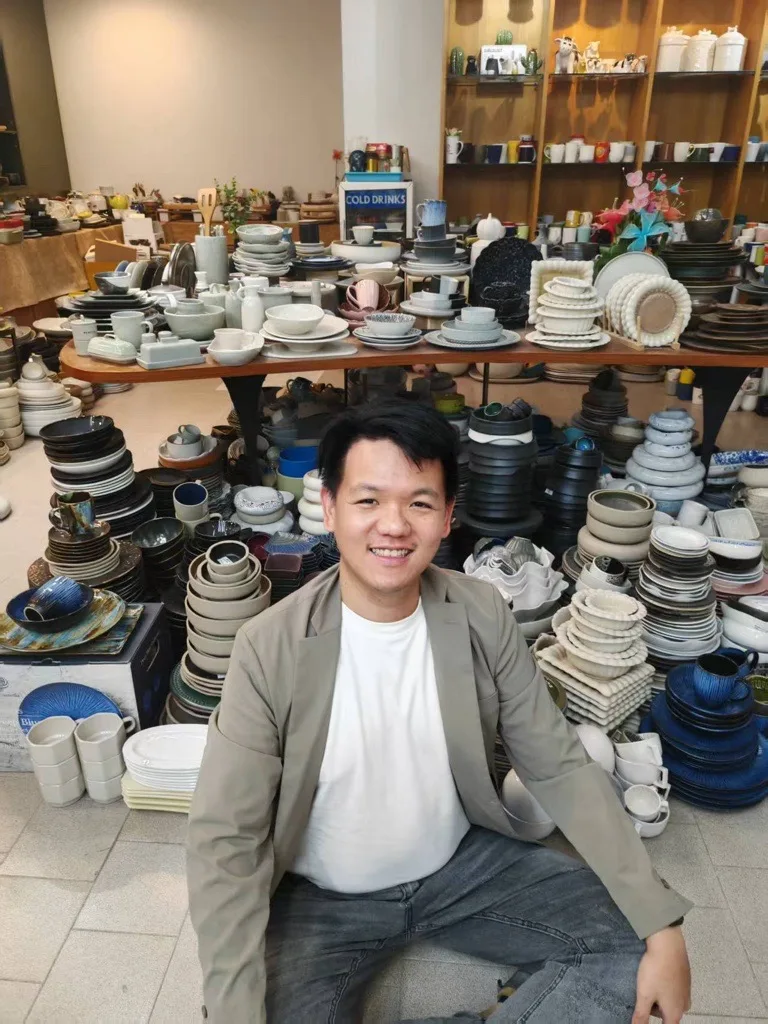
Jeffrey Chen is the second-generation CEO of Jason Craft Corporation, a Taipei-based sourcing and product development company founded in 1981. More about Jeffrey · About Jason Craft.